
The Complete Guide to Institutional Furniture for Summer Camps
Key Takeaways:
- High-quality summer camp furniture must meet institutional standards, as consumer-grade options cannot withstand the heavy, repetitive use of camp environments.
- Durable cabin furniture for summer camps depends on solid materials, multi-point joinery, and refinishable finishes that extend lifespan and maintain structural integrity.
- Safe and reliable institutional furniture for sleeping areas requires integrated guardrails, stable frames, and ladders designed for consistent, secure use.
- Investing in commercial-grade furniture helps camps manage seasonal wear, reduce replacement costs, and maintain performance through both active use and off-season storage.
Furnishing a summer camp is not a task that lends itself to guesswork. The furniture that goes into cabins, dining halls, and common areas will be used by hundreds of campers across multiple seasons, exposed to humidity, heavy activity, and the full energy of kids living and moving through shared spaces. Decisions made at the purchasing stage determine how a camp looks, how it operates, how safe the sleeping environment is, how manageable maintenance becomes, and whether the investment made this season still holds up five, 10, or 15 years from now.
This guide is designed to give camp directors and facilities managers a clear, practical framework for evaluating summer camp furniture from the ground up. It covers the construction features that define genuine durability, the safety considerations that matter most in shared sleeping spaces, the material choices that simplify maintenance, and the layout strategies that make the most of limited square footage. Whether you are outfitting a new facility or reassessing aging inventory, the goal is to help you make decisions that serve your camp well for the long term.
Why Standard Furniture Falls Short in Camp Environments
The first thing worth understanding is why commercial-grade furniture is a necessity in camp settings rather than a premium upgrade. Consumer furniture is designed for moderate, predictable use in household settings. A dining chair in a home might seat the same four people at the same table for years. A chair in a camp dining hall seats a rotating cast of active kids multiple times a day, gets moved, stacked, scraped across floors, and generally subjected to the kind of sustained physical stress that residential furniture is simply not engineered to handle.
The performance gap between consumer and institutional furniture shows up in predictable ways: Joints loosen from lateral stress, surface finishes chip and peel under repeated cleaning, drawer slides stick or fail, and bed frames begin to flex and rock within a season or two of heavy use. The cost of replacing furniture that underperforms is not just financial. It creates operational disruption at exactly the moments when camp staff have the least capacity to deal with it.
Durable summer camp furniture built to institutional standards addresses these vulnerabilities through material selection, construction method, and finish quality. Understanding what that means in practice is what allows camp directors to evaluate options meaningfully rather than relying on marketing language alone.
The Construction Features That Define Durability
Genuine durability in cabin furniture for summer camps comes down to a consistent set of construction principles. These are the features worth examining closely when evaluating any furniture purchase for institutional use.
Material selection is the foundation. Solid wood, especially dense, stable species like Southern Yellow Pine, provides the structural strength and repairability that institutional settings require. Unlike engineered wood products such as particleboard or medium-density fiberboard (MDF), solid wood holds fasteners reliably over time, resists the joint loosening that develops under repeated lateral stress, and can be sanded and refinished when surface wear occurs.
Joinery and fastening determine how long a piece maintains its structural integrity under stress. Multi-point fastening distributes stress across multiple connection points and resists the racking and flex that develops in furniture that is moved, leaned on, and occupied by active users repeatedly. Single-method fastening, whether staples or screws alone, concentrates stress at fewer points and loosens more quickly under institutional demand.
Protective finishes seal and protect the wood surface against moisture penetration, staining, and wear. Water-based lacquer finishes applied in multiple coats and hand-sanded between stages create a smooth, durable surface that stands up to institutional cleaning protocols and can be refreshed with light sanding and restaining when needed. This refinishability is a meaningful advantage over engineered wood surfaces, which cannot be restored once the veneer or laminate is compromised.
| Construction Feature | What to Look For | Red Flag |
| Material | Solid wood or steel | Particleboard, MDF |
| Fastening method | Screws + glue + nails | Staples or single-method only |
| Finish | Multi-coat water-based lacquer | Thin veneer or decorative laminate |
| Repairability | Sandable, refinishable surfaces | Non-repairable surface damage |
| Expected lifespan | 10–20+ years in heavy use | Manufacturer avoids lifespan claims |
Key Takeaway: Material quality, multi-point joinery, and refinishable topcoats are the three construction features that most reliably predict how long furniture will perform in institutional camp settings.
Bunk Beds and Sleeping Spaces: Safety First 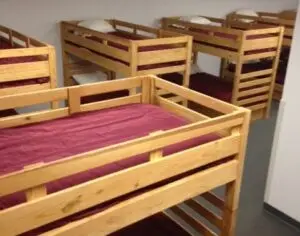
Sleeping arrangements are where furniture decisions carry the greatest impact for camper safety. The safety features that matter most in institutional bunk beds are consistent regardless of whether wood or steel construction is used.
Guardrail coverage on upper bunks should extend a minimum of five inches above the top of the mattress on all open sides. Guardrails that are integrated into the frame as a structural component are more reliable over time than those bolted on as accessories. In a camp environment where beds are occupied nightly by active kids, that distinction in construction approach has real safety implications.
Ladder design determines how safely campers navigate to and from upper bunks, including in low-light conditions. Rungs should be wide enough for stable footing, textured or grooved to reduce slip risk with bare feet, consistently spaced, and firmly attached without flex or movement when weight is applied.
Frame stability is the foundation that everything else depends on. A bunk frame that flexes, rocks, or shifts under weight is a safety liability regardless of guardrail quality. Multi-point fastening and quality panel construction are what prevent the frame flex that develops in lower-quality bunks over time.
Weight capacity ratings deserve scrutiny as well. Institutional bunk beds should be rated for dynamic loads and the impact of climbing, shifting, and sitting on the edge of an upper bunk rather than just static weight. A frame engineered for genuine institutional load tolerances will perform reliably across years of camper turnover.
Key Takeaway: Guardrail integration, ladder design, frame stability, and dynamic weight capacity are the non-negotiable safety features in institutional bunk beds. Each should be evaluated carefully before any purchasing decision.
Seasonal Use, Storage, and Material Integrity
Summer camps operate on a compressed seasonal calendar that creates a specific set of durability challenges beyond what year-round institutional facilities face. Furniture absorbs intense use during a short active window, then sits in storage, often in unheated, uninsulated buildings, through fall and winter before being returned to active use the following season. This cycle introduces two distinct stress phases that both affect how durable summer camp furniture performs over time.
During the active season, the intensity of use is the primary stressor. A set of bunks might host a new camper rotation every one to two weeks throughout an eight-to-10-week season, with each rotation introducing different weights, habits, and energy levels. Common areas see furniture moved, stacked, and repositioned constantly. The cumulative structural stress is substantial and accelerates the failure of furniture not built for institutional loads.
During the off-season, moisture and temperature fluctuation become the primary threats. Wood that has not been properly dried and finished absorbs humidity during storage, expanding and contracting in ways that weaken glue joints, warp panels, and compromise structural integrity. Furniture that goes into storage looking fine can emerge in spring, requiring significant repair if the underlying material is not dimensionally stable.
Proper end-of-season maintenance practices extend furniture life considerably across both stress phases. A practical seasonal routine includes inspecting and tightening all joints before and after the season, lightly sanding and restaining any worn surface areas before storage, ensuring all pieces are fully dry before moving to storage, and inventorying replacement parts so any needed components can be ordered before the next season begins.
Key Takeaway: Seasonal camp furniture faces two distinct stress phases: intense active-season use and off-season storage conditions. Both require consideration when selecting materials and establishing maintenance routines.
Space Optimization in Cabins and Common Areas
Camp facilities are rarely designed with surplus square footage. Cabins, bunk rooms, and common spaces need to accommodate multiple occupants comfortably while preserving enough open floor area for movement, personal organization, and daily activity. Furniture selectionand layout strategy both contribute to how well a space functions at full occupancy.
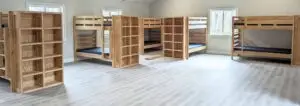
In sleeping areas, vertical configurations are the most effective tool for maximizing capacity without expanding footprint. Twin-over-twin bunks are the most common approach, but triple bunks and lofted configurations are worth considering in rooms with adequate ceiling height. Corner and L-shaped arrangements use wall space efficiently and can free up central floor area that straight parallel layouts consume.
Storage integration is equally important. Under-bed drawers, end-of-bunk chests, and built-in shelving reduce the need for freestanding storage pieces that consume floor space and add to the visual density of a room. When storage is designed into, or alongside, sleeping furniture, shared rooms feel more organized and are easier to maintain.
In common areas, the priority shifts toward furniture that can be reconfigured easily for different activities and group sizes. Tables and seating that stack or nest reduce the footprint when spaces are not in full use and simplify the kind of quick room transitions that camp programming frequently requires.
Key Takeaway: Vertical sleeping configurations, integrated storage, and flexible common area furniture are the layout strategies that most effectively maximize usable space in camp facilities without sacrificing comfort or functionality.
Choosing a Furniture Partner That Understands Camp Demands
Outfitting a summer camp with institutional furniture is a long-term investment. The right furniture partner brings more than a product catalog. They bring the expertise to help facilities make decisions that hold up across years of seasonal use, the infrastructure to support those decisions after the sale, and the manufacturing standards that make institutional-grade performance possible in the first place.
Jess Crate has spent nearly two decades supplying commercial-grade furniture to camps, residential facilities, treatment centers, and group homes across the country. Every piece is handcrafted in a 45,000-square-foot factory in North Carolina using Southern Yellow Pine dried to under 10% moisture content, assembled with multi-point fastening, and finished with a water-based lacquer applied and hand-sanded across multiple stages. Factory-direct pricing means institutions receive genuine institutional construction without distributor markup, and in-house sales expertise means the purchasing process is supported by people who understand the specific demands of camp and institutional environments.
Explore our crate furniture line for handcrafted wood cabin and bunk options, the steel furniture collection for metal frame alternatives, and mattresses and linens to complete sleeping arrangements with components built to the same institutional standard. For outdoor spaces, the outdoor furniture line extends the same durability focus to exterior environments. Browse the full range to find the right configuration for your facility’s specific needs and occupancy demands.