
What Makes Bunk Beds Heavy-Duty? A Buyer’s Guide for Camps
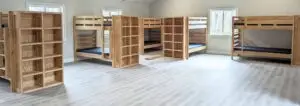
Key Takeaways:
- High-quality commercial bunk beds are defined by structural engineering that supports dynamic loads, not just static weight ratings, ensuring long-term durability in camp environments.
- Durable institutional bunk beds rely on reinforced joints, multi-point fastening, and high-grade materials to withstand repeated use and prevent long-term structural failure.
- Meeting bunk bed safety standards requires integrated guardrails, proper mattress-to-rail height ratios, and safe spacing to protect campers in real-world conditions.
- Effective bunk bed ladder safety depends on stable attachment, proper rung spacing, and slip-resistant surfaces to ensure safe, consistent access to upper bunks.
When camp directors start evaluating bunk beds, the options can feel overwhelming. Price points vary widely, product descriptions lean heavily on marketing language, and it is not always obvious what separates a bunk bed that will hold up for fifteen years from one that will need replacing after three seasons. Understanding what actually makes commercial bunk beds heavy-duty is what allows facilities managers to make purchasing decisions they will not regret.
Institutional bunk beds are engineered to a fundamentally different standard than anything available in a retail furniture store. They are built for repeated occupancy by users of varying sizes, designed to withstand constant movement and stress, and expected to perform reliably across years of heavy seasonal use. Whether you are considering wood or institutional metal bunk beds, the construction features that define true durability are consistent and worth knowing before you buy.
Weight Capacity: The Baseline That Everything Else Builds On
Weight capacity is the most fundamental specification to evaluate when comparing commercial bunk beds, and it is often where lower-quality options fall short in ways that are not immediately visible. A bunk bed that looks structurally sound may be engineered for load tolerances that are appropriate for a guest room but completely inadequate for a camp cabin.
In institutional settings, weight capacity needs to account for more than the static weight of a single occupant. It needs to accommodate dynamic loads such as the impact of a camper climbing a ladder, shifting position during sleep, or sitting on the edge of an upper bunk. These forces can exceed static weight significantly, and frames that are not engineered for them will flex, loosen, and eventually fail.
When evaluating capacity, look beyond the listed weight rating and examine how that capacity is achieved structurally. The relevant factors include:
- Thickness and grade of lumber or steel used in the frame
- Number and placement of support slats across the sleeping surface
- How the upper bunk connects to and is supported by the lower frame
- Whether the frame uses corner blocking or additional reinforcement at high-stress joints
A frame that meets high weight capacity ratings through genuine structural engineering rather than optimistic specifications is the foundation of a bunk bed that will perform reliably across a full camp season and many seasons beyond.
Key Takeaway: Weight capacity ratings should reflect dynamic load tolerance, not just static weight. Understanding how a frame achieves its capacity is more informative than the number alone.
Structural Reinforcement: Where Construction Quality Shows 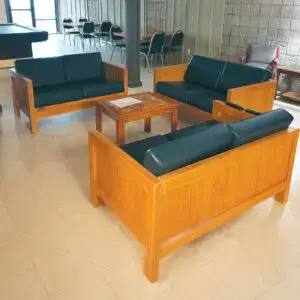
The difference between a well-built institutional bunk and a consumer-grade alternative often comes down to what happens at the joints. Joints are where stress concentrates, where movement occurs, and where lower-quality construction begins to fail first.
Truly heavy-duty institutional bunk beds use multi-point fastening at every joint, typically a combination of screws, glue, and nails rather than any single fastening method alone. This approach distributes stress across multiple connection points and significantly increases resistance to the racking and lateral movement that develops over time in high-use environments.
For wood bunk beds, panel construction matters as well. Jess Crate builds its crate furniture line using edge-glued Southern Yellow Pine panels laminated with premium wood glue, producing a sleeping surface and frame structure that resists warping and maintains its integrity through seasonal humidity and temperature changes. For facilities that prefer metal construction, Jess Crate’s steel furniture collection offers comparable structural integrity with the added benefit of metal’s resistance to moisture-related degradation.
Key Takeaway: Multi-point fastening at joints and quality panel or frame construction are the most reliable indicators of structural integrity in institutional bunk beds. These details separate genuinely heavy-duty options from those that merely appear to be.
Bunk Bed Safety Standards: Rails, Guards, and Compliance
Meeting recognized bunk bed safety standards is a non-negotiable baseline for any camp purchasing decision. Beyond compliance, however, safety features should be evaluated for how well they are integrated into the frame design rather than added on as accessories.
Guardrails on upper bunks should extend a minimum of five inches above the top of the mattress on all open sides. Rails that are bolted on after the fact using external hardware are generally less reliable over time than those built as a structural component of the frame. In a camp environment where beds are used nightly by active kids, that distinction matters.
Mattress platform depth also affects safety in ways that are easy to overlook. A platform that positions the sleeping surface too high relative to the guardrail height reduces the effective protection the rail provides. When evaluating safe bunk beds, the relationship between mattress thickness, platform depth, and guardrail height should all be considered together rather than in isolation.
Safety rails for bunk beds should also be assessed for the gaps between rail components. Openings large enough for a camper’s head or limbs to become trapped are a recognized hazard and a point of evaluation in most institutional safety frameworks. Well-designed guardrail systems close these gaps without compromising the accessibility needed for making beds and general cabin use.
Key Takeaway: Guardrail integration, mattress-to-rail height ratios, and gap sizing are the key safety rail details that determine whether a bunk bed genuinely meets institutional safety standards or simply meets minimum specs on paper.
Bunk Bed Ladder Safety: A Detail That Deserves More Attention
Ladders are among the most frequently overlooked components in bunk bed evaluations, yet bunk bed ladder safety is directly relevant to how often campers successfully navigate to and from upper bunks without incident, including in low-light conditions at night.
A well-designed institutional ladder should meet several practical criteria:
- Rung width: Wide enough for a secure foothold, typically a minimum of 16 inches
- Rung spacing: Consistent and appropriate for the age range of campers using the beds
- Rung surface: Textured or grooved to reduce slip risk, particularly with bare feet
- Attachment: Firmly fixed to the frame without flex or movement when weight is applied
- Angle: Positioned at an angle that allows for a natural, stable climbing motion rather than a straight vertical climb
Ladders that wobble, have smooth rungs, or are spaced inconsistently introduce unnecessary risk into a transition that campers make multiple times each day. This is one area where the quality of institutional design shows clearly compared to consumer-grade alternatives.
Key Takeaway: Ladder width, rung texture, spacing, and attachment stability are the practical features that determine how safely campers can access upper bunks under real camp conditions.
Choosing the Right Bunk for Your Facility
Heavy-duty bunk beds are one of the most consequential furniture investments a camp can make. They are used every night, by every camper, for the full duration of the season — and they need to perform safely and reliably without requiring constant attention from facilities staff.
Whether your facility is best served by solid wood construction or a steel frame configuration, Jess Crate offers purpose-built options designed specifically for institutional shared sleeping environments. Explore the crate furniture line for handcrafted wood bunk options, the steel furniture collection for metal frame alternatives, and mattresses and linens to complete your sleeping arrangements with components built to the same institutional standard. Browse the full range at jesscrate.com to find the right configuration for your camp.