
Space-Saving Furniture Solutions for Multi-Occupant Bedrooms

Key Takeaways:
- Space-saving bunk bed designs for small rooms maximize vertical space with configurations like triple bunks and lofted beds to increase capacity without expanding footprint.
- Integrated storage solutions for bunk rooms reduce clutter by incorporating drawers, shelving, and cubbies directly into furniture, eliminating the need for extra pieces.
- Multi-use furniture for small spaces improves functionality by combining storage, seating, and workspace features into fewer, more efficient pieces.
- Group living furniture for institutional settings ensures durability and long-term performance in high-occupancy environments like camps, dorms, and residential facilities.
Shared sleeping spaces present a consistent challenge: fitting enough beds, storage, and personal space into a room that was not always designed with high occupancy in mind. Whether you are managing a summer camp cabin, a group home, a residential treatment facility, or a dormitory, the principles of effective bunk room design are the same. The goal is to maximize usable square footage without making the space feel cramped or institutional in a way that works against the people living in it.
Good bunk room designs start with the right furniture. Specifically, limited space bunk bed designs for small rooms, integrated storage solutions, and multi-use furniture that serves more than one function without adding footprint. When these elements work together, even a modest room can accommodate multiple occupants comfortably. Group living furniture designed for institutional settings brings the added advantage of durability, ensuring the configuration you install holds up through years of occupancy rather than requiring constant reconfiguration and replacement.
Bunk Configurations That Make the Most of Vertical Space
The most direct way to increase sleeping capacity in a shared room is to think vertically. Standard twin-over-twin bunk beds are the most familiar approach, but they are far from the only option. The right configuration depends on ceiling height, room dimensions, and the age and needs of the occupants.
A few configurations worth considering for multi-occupant settings:
- Twin-over-twin bunks remain the most versatile option for most camp and residential settings, offering straightforward access and compatibility with standard mattress sizes.
- Triple bunks introduce a third sleeping surface in the same floor footprint, which is particularly useful in rooms where wall space is limited but ceiling height allows it.
- L-shaped bunk configurations make use of corner space that standard parallel arrangements leave unused, often freeing up central floor area for movement and shared use.
- Lofted beds with storage or desk space below work well in settings where residents need a dedicated personal area and sleeping capacity does not require a lower bunk.
Space-saving bunk bed designs for small rooms are most effective when the bunk layout is planned in relation to the room as a whole, including door swing, window placement, and traffic flow between beds. A well-planned layout prevents the space from feeling crowded even at full occupancy.
Key Takeaway: Vertical sleeping configurations, including triple bunks, lofted beds, and corner arrangements, significantly increase room capacity without expanding the floor footprint. The right choice depends on ceiling height, room shape, and occupant needs.
Integrated Storage: Reducing Clutter Without Adding Furniture 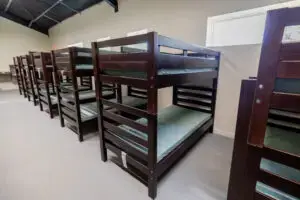
In multi-occupant rooms, personal belongings multiply quickly. Without adequate storage built into or alongside sleeping arrangements, floors and surfaces fill up fast, and that can create both a cleanliness challenge and a safety hazard in tight spaces.
The most space-efficient approach to storage in shared rooms is to integrate it directly into the furniture rather than adding separate freestanding pieces. Options that work well in institutional settings include:
- Under-bed drawers that use the space beneath lower bunks for clothing and personal items.
- Chests and dressers sized to fit at the foot of a bunk without blocking access or traffic paths.
- Shelving integrated into bunk end panels for personal items, books, and daily essentials.
- Lockers or cubby systems along wall space that would otherwise go unused.
Multi-use furniture for small spaces is particularly valuable in this context. A chest that doubles as a seat, a storage unit that functions as a room divider, or an under-bunk drawer system that eliminates the need for a separate dresser all help reduce the total number of pieces in the room while increasing functionality.
Key Takeaway: Integrated storage built into or alongside sleeping furniture reduces clutter and eliminates the need for additional freestanding pieces, keeping shared rooms functional and easier to navigate.
Multi-Use Furniture That Works Harder in Less Space
Beyond sleeping and storage, shared rooms often need to accommodate other daily functions, such as getting dressed, doing homework, or simply having a surface to set things on. In rooms where floor space is limited, multi-use furniture that handles more than one of these needs without requiring additional square footage is worth prioritizing.
Tables that fold flat against the wall when not in use, seating that doubles as storage, and desks integrated into lofted bed frames are all practical examples of this approach. For facilities managing multiple rooms, versatile pieces also simplify inventory, replacement, and reconfiguration over time.
The key is selecting multi-use furniture built to institutional standards. Pieces that are designed for residential or light commercial use often cannot sustain the constant handling that shared occupancy environments generate. Group living furniture from manufacturers who understand institutional demand is engineered to handle repeated daily use across multiple occupants without the joint loosening and surface wear that affects lighter-duty alternatives.
Key Takeaway: Multi-use furniture reduces the total number of pieces needed in a shared room while maintaining functionality. Institutional-grade construction ensures these pieces hold up under the demands of group living environments.
Designing Shared Rooms That Work for Everyone
Effective shared room design is about more than fitting the maximum number of beds into a space. It is about creating an environment where multiple occupants can coexist comfortably, access their belongings easily, and move through the room without friction. The right furniture makes that possible without requiring a larger footprint.
If you are planning or refreshing a multi-occupant space, our crate furniture line offers bunk configurations, storage solutions, and complementary pieces designed specifically for shared institutional environments. For settings where additional structural strength is a priority, the steel furniture collection provides equally durable options in a metal frame format. Explore the full range at jesscrate.com to find configurations suited to your facility’s specific layout and occupancy needs.